

PA-100 AST System: bringing the power of laboratory testing to the doctor’s office [1]
Urinary tract infections (UTI) are one of the most common bacterial infections and one of the driving causes of antibiotic prescription worldwide [2,3] so why should it take days to wait for diagnostic results? Diagnosis of UTIs remains a clinical challenge [4], since most general practitioners prescribe with the patient in front of them while making a clinical diagnosis – it’s an informed guess backed by local and national guidance [1].
Now, the PA-100 AST System brings the power of laboratory testing into the doctor’s office and minimises waiting times [1] with AST (antibiotic susceptibility testing) at the point of need.
Key benefits of the PA-100 AST System
- Targeted UTI treatment from the first visit: Make informed treatment decision based on timely results from your patient’s first visit.
- Rapid AST, accurate analysis: Get UTI test results and targeted antibiotic prescription in 45 minutes.
- Personalised treatment: Identify the most effective antibiotic for each patient, minimising the risk of antimicrobial resistance. [6]
- Improved patient outcomes: Has the potential to prevent the development of chronic or severe UTIs and lower potential treatment failure by reducing ineffective empiric treatment [5].
Ask the expert: Why PA-100 AST is a game changer in UTI diagnosis and treatment

How can the PA-100 AST cut 2-3 days of waiting time – down to just 45 minutes? Watch the expert testimonial to find out.
Rethinking routine UTI testing and boosting diagnosis confidence [1]
When it comes to the diagnosis of urinary tract infection, symptoms remain the cornerstone, with urine cultures only being necessary when empirical treatment fails, recurrent UTI symptoms are present or when antimicrobial resistance (AMR) is suspected [7].
“Treatment of UTI is generally done empirically, which has been reported to lead to inappropriate antibiotic treatment in up to 50% of cases. [10]”


A prospective, non-interventional study compared PA-100 AST System outcomes to clinical decisions and found that the overall frequency of optimal treatment could have been significantly higher when the PA-100 AST System was used compared to clinical decision [5].

For everyday infections like UTIs, the opportunity of a near-patient testing device provides a unique tool to select antibiotics tailored to each infectious episode. Watch the video to learn more.
Targeted antibiotic treatment from the first visit
A new study explored how the PA-100 AST System can influence antibiotic choices in primary care.
The PA-100 AST System revealed unexpectedly high fosfomycin resistance in
This significantly changed the antibiotic prescription behaviour away from fosfomycin towards nitrofurantoin and amoxycillin/ clavulanic acid” (p < 0.001) (10)

PA-100 AST System ends ‘just-in-case prescribing’ of antibiotics for UTI treatment [1]
The PA-100 AST System replaces the current 2–5-day laboratory testing process by simply adding a urine sample to the cartridge in the PA-100 AST System. The PA-100 AST System detects the presence of a bacterial infection in just 15 minutes, and the antibiogram is completed within 45 minutes [1].
A prospective, non-interventional study compared clinical decisions to PA-100 outcomes and concluded that the PA-100 AST System could have enabled rapid initiation of the correct targeted treatment, thus significantly improving the treatment of patients with UTI [5].


Watch this video to learn how the PA-100 AST System empowers clinicians to provide better care for patients.
Reduce hospitalisation with effective UTI treatment [1, 9]
In addition to better clinical outcomes for the patient, prevention of more serious conditions preserves resources for the health system [1]. Effective UTI treatment from the outset prevents patients from going on to develop complicated urinary tract infections or urosepsis.
Dr Brown, Consultant Medical Microbiologist at Cambridge University Hospitals says, “Giving the right antibiotic as quickly as possible improves patient outcomes, not only in terms of the time it takes for symptoms to get better, but in terms of rare but significant complications like sepsis and hospital admissions [1].”
Using the PA-100 AST System is this easy
- Simple to use: Minimal sample handling wherein native urine is pipetted into the sample cartridge. No sample pretreatment needed.
- Rapid analysis: The device analyses the sample for bacteriuria, then identifies the most suitable antibiotic within 45 minutes.
- Targeted treatment: Provide patients with the right antibiotic for their infection, ensuring effective treatment and promoting antimicrobial stewardship.
Recent budget impact modelling suggests that introducing the PA-100 AST System into Spanish public healthcare could significantly improve cost-efficiency in UTI management.
The analysis projects potential savings of approximately €323 million in the first year assuming 100% adoption. Over three years, cumulative cost reductions are projected -- driven by fewer secondary complications, hospital admissions, and lower direct costs such as productivity losses.
Expert opinion: Targeted antibiotic therapy from sample to result in 45 minutes

Why is rapid, targeted antibiotic treatment the biggest challenge in managing UTIs? Discover how the PA-100 AST can transform patient care by watching this expert testimonial.

How can the PA-100 AST help guide rapid diagnosis and treatment of UTIs in clinical practice? See how it supports faster, more accurate decisions.
Watch how PA-100 AST System works in a 4 dimensional video
Discover how rapid, personalised antibiotic testing works in practice. The PA-100 AST System supports confident clinical decisions within a single patient visit.
We’re honoured to have won the Longitude Prize on AMR
Challenge Works, a social enterprise that delivers challenge prizes that incentivise cutting-edge innovation for social good, launched the Longitude Prize on AMR to create the urgent ‘pull’ needed to tackle one of the biggest global health challenges of our lifetime [8]. The Sysmex PA-100 AST System was deemed a valuable test because it is accurate, easy-to-use and affordable. “Awarding the prize to this technology marks a turning point in which clinicians can be better equipped to diagnose and treat patients,” said Michael Corley, Deputy Chief Executive Officer at British Society for Antimicrobial Chemotherapy.
There are seven reasons we won the prize. Want to read about them? Click here.
Posters

The study showed that the Sysmex PA-100 AST system provided reliable AST outcomes, demonstrating potential for faster targeted therapy and enhanced antimicrobial stewardship. Results indicated clinical utility even with samples up to 120 minutes old, exceeding the standard 30-minute recommendation for fresh urine. When combined with pre-screening, the system showed potential for tertiary care settings involving older or complex samples from complicated UTIs. Baltekin Ö et al. (2026): ESCMID 2026: Evaluation of a Point-of-Care Ultra-Rapid Direct AST System for Diagnosing UTIs in a Tertiary Care Setting. Summary: In this study, the performance of the Sysmex PA-100 AST System was assessed for rapid detection of bacteriuria and direct phenotypic antimicrobial susceptibility testing (AST) in females with suspected urinary tract infections. Including 239 clinical urine samples from a tertiary care hospital, the system delivered AST results within 45 minutes. The authors conclude that the PA-100 provides reliable, rapid susceptibility results directly from urine samples, supporting earlier targeted treatment and improved antimicrobial stewardship, even when samples are analysed up to two hours after sample collection.
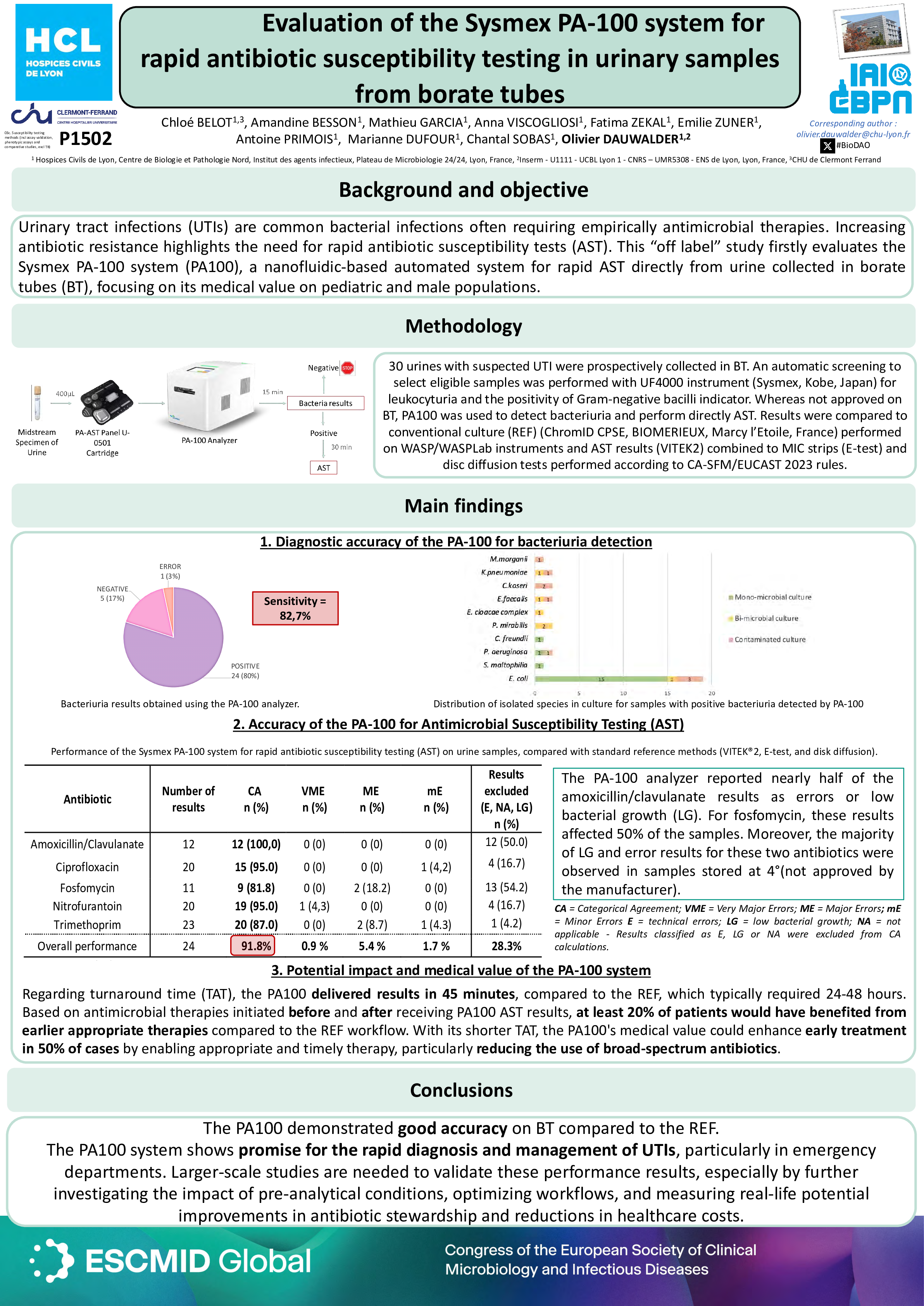
Urinary tract infections (UTIs) are common bacterial infections often requiring empircal antimicrobial therapies. Increasing antibiotic resistance highlights the need for rapid antibiotic susceptibility tests (AST). This “off-label” study firstly evaluates the Sysmex PA-100 system (PA100), a nanofluidic-based automated system for rapid AST directly from urine collected in borate tubes (BT), focusing on its medical value on pediatric and male populations. Belot C et al. (2025): Evaluation of the Sysmex PA-100 system for rapid antibiotic susceptibility testing in urinary samples from borate tubes. Summary: In this prospective study, the performance of the PA-100 AST System was evaluated for rapid antimicrobial susceptibility testing (AST) directly from urine samples collected in borate tubes. Among 30 suspected urinary tract infection samples, the system detected bacteriuria with a sensitivity of 82.7% and delivered AST results within 45 minutes, compared with 24–48 hours for conventional methods. The authors conclude that the PA-100 could supports earlier targeted therapy and reduce unnecessary broad-spectrum antibiotic use, and the potential use of preserved urine samples from borate tubes, which is an off-lable use.
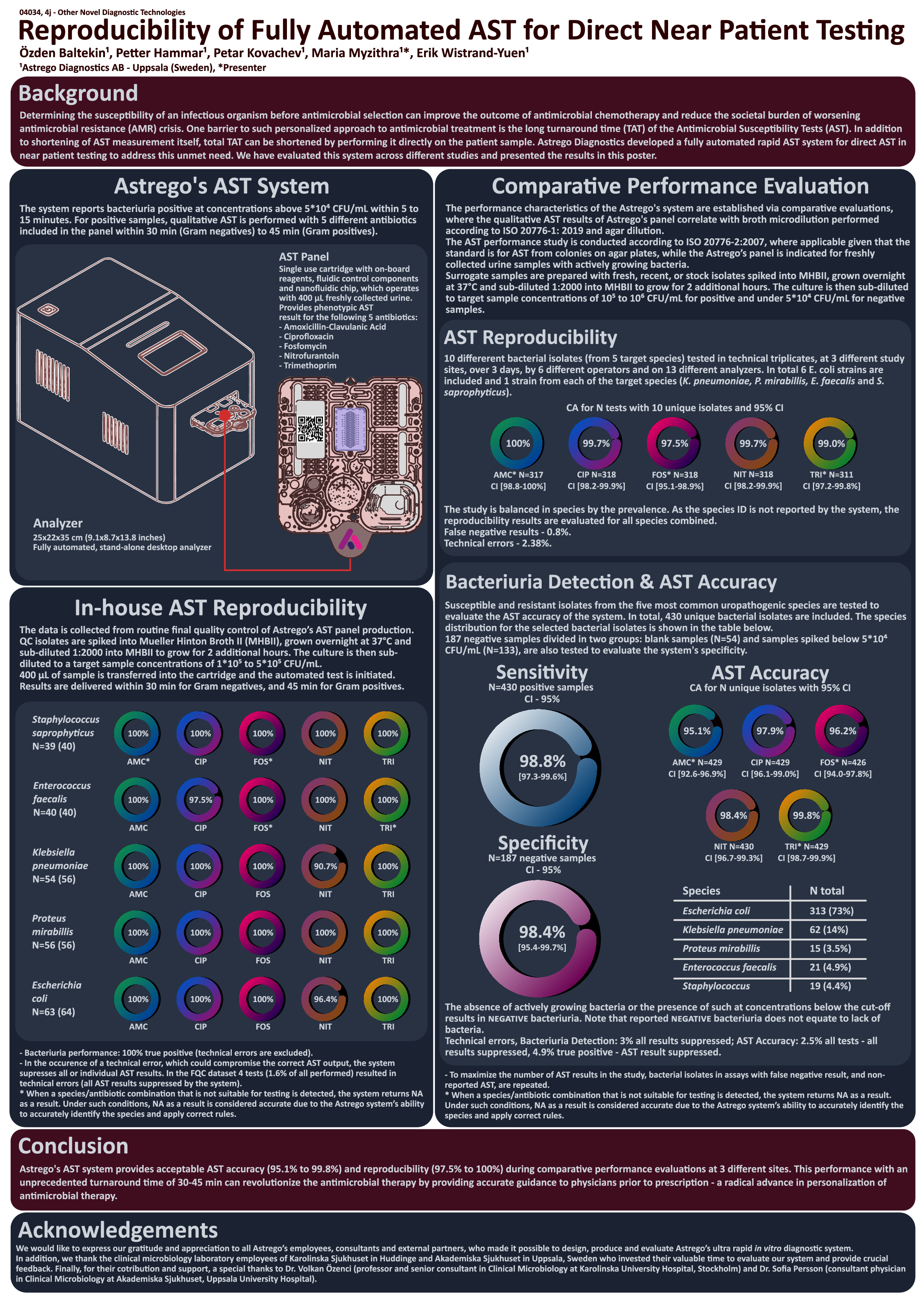
Astrego’s AST system provides acceptable AST accuracy (95.1% to 99.8%) and reproducibility (97.5% to 100%) during comparative performance evaluations at 3 different sites. This performance with an unprecedented turnaround time of 30-45 minutes can revolutionise the antimicrobial therapy by providing accurate guidance to physicians prior to prescription. Baltekin Ö et al. (2024): Reproducibility of Fully Automated AST for Direct Near Patient Testing. Summary: In this study, the performance of the fully automated rapid antimicrobial susceptibility testing (AST) system for urinary tract infections evaluated in comparison to conventional microbiology. The platform directly processes fresh urine samples, detecting bacteriuria within 5–15 minutes and providing susceptibility results for five antibiotics within 30–45 minutes. Multi-site studies demonstrated excellent reproducibility (97.5–100%), while testing of 430 clinical isolates demonstrated AST accuracy of 95.1–99.8% and bacteriuria detection sensitivity of 98.4%. The authors conclude that the PA-100 can deliver reliable, near-patient AST much faster than conventional methods, supporting earlier targeted antibiotic prescribing and improved antimicrobial stewardship.
Publications

Martínez-Berganza Asensio L et al. (2026):
Impact of PA-100 AST System rapid antibiotic susceptibility test on Antibiotic prescription for community-acquired urinary tract infections in Spanish Primary care System
Summary: In this interventional study, potential improvements in the management and antibiotic treatment of community-acquired urinary tract infections in females, attending primary healthcare in Spain with access to the PA-100 AST System. In this setting, the PA-100 identified fosfomycin resistance in 21.5% of confirmed infections, leading to significant changes in prescribing practice. The authors conclude that the PA-100 may support antimicrobial stewardship by enabling more targeted, evidence-based antibiotic selection during the initial patient visit.

Elsisi GH et al. (2024):
Impact of PA-100 AST System Rapid Antibiotic Susceptibility Test on Antibiotic Prescription for Community-Acquired Urinary Tract Infections in Spanish Primary Care Settings.
Summary: This study evaluated the economic impact of integrating the Sysmex PA-100 for managing uncomplicated urinary tract infections (uUTI) in Spain. A budget impact model analyzed the costs of current uUTI management versus incorporating the Sysmex PA-100, focusing on direct medical and indirect costs over three years. In conclusion, the hypothetical adoption of the Sysmex PA-100 demonstrated potential cost savings through timely diagnosis and treatment, reduced complications, and decreased staff time, supporting its implementation for better uUTI management and resource allocation in Spanish healthcare.

Alonso-Tarrés C et al. (2024):
Bacteriuria and phenotypic antimicrobial susceptibility testing in 45 minutes by point-of-care Sysmex PA-100 System: first clinical evaluation.
Summary: In this study the performance of the PA-100 was compared against routine microbiology data for the detection of uncomplicated UTI and performance of ASTs directly from urine. Sensitivity and specificity for detection of confirmed bacteriuria within 15 minutes were 84.0% and 99.4%, respectively, for bacterial species, included in the analyser specification, such as E. coli, K. pneumoniae, P. mirabilis, E. faecalis and S. saprophyticus. Therefore, the authors concluded that the PA-100 could enable a rapid initiation of the correct treatment of uncomplicated UTI with potential impact on antimicrobial stewardship.

Baltekin Ö et al. (2017):
Antibiotic susceptibility testing in less than 30 min using direct single-cell imaging.
Summary: In this study, a rapid point-of-care test for urinary tract infections (UTIs) was introduced, utilising a custom microfluidic chip, able to capture individual bacterial cells directly from low-level bacteriuria samples and monitor their growth under microscopy. Through evaluation of bacterial response to antibiotics at the single-cell level, antibiotic susceptibility could be detected within minutes. The method was tested against nine commonly used UTI antibiotics and successfully identified growth-rate changes rapidly (11)
Learn more about near-patient testing solutions



References
[1] Challenge Works - Longitude Prize on AMR (2024): Implementing Rapid Diagnostic tests for UTI in the UK healthcare system
[2] Tomlinson E, Jones HE, James R, Cooper C et al. (2024): Clinical effectiveness of point of care tests for diagnosing urinary tract infection: a systematic review Clin Microbiol Infect 30(2):197-205
[3] Pujades-Rodriguez M, West RM, Wilcox MH, Sandoe J (2019): Lower Urinary Tract Infections: Management, Outcomes and Risk Factors for Antibiotic Re-prescription in Primary Care EClinicalMedicine 14:23-31
[4] Claeys KC, Blanco N, Morgan DJ, Leekha S et al. (2019): Advances and Challenges in the Diagnosis and Treatment of Urinary Tract Infections: the Need for Diagnostic Stewardship Curr Infect Dis Rep 21(4):11
[5] Alonso-Tarrés C, Benjumea Moreno C, Navarro F, Habison AC, et al. (2024): Bacteriuria and phenotypic antimicrobial susceptibility testing in 45 min by point-of-care Sysmex PA-100 System: first clinical evaluation Eur J Clin Microbiol Infect Dis 43(8):1533- 1543
[6] Challenge Works - Longitude Prize on AMR (2020): The long read - We must do better for UTI patients
[7] Wagenlehner F, Nicolle L, Bartoletti R, Gales AC et al. (2021): A global perspective on improving patient care in uncomplicated urinary tract infection: expert consensus and practical guidance J Glob Antimicrob Resist. 28:18-29
[8] Challenge Works (2024): Longitude Prize on AMR
[9] Gihan Hamdy Elsisi, Hanan Saady Zaky & José Medina Polo (2024): Budget impact analysis on the use of Sysmex PA-100 AST system as a point of care for uncomplicated urinary tract infections detection and treatment in Spanish females Journal of Medical Economics, 27:1, 1434-1443
[10] Martínez-Berganza Asensio L, Largo-Rojo G, Menéndez-Fernández AI, Solano-Villarrubia C, et al. (2026): Impact of PA-100 AST System Rapid Antibiotic Susceptibility Test on Antibiotic Prescription for Community-Acquired Urinary Tract Infections in Spanish Primary Care Settings. Antibiotics (Basel) 15(5):520
[11] Baltekin Ö, Boucharin A, Tano E, Andersson DI, Elf J (2017): Antibiotic susceptibility testing in less than 30 min using direct single-cell imaging. Proc Natl Acad Sci USA 114(34):9170-9175